Brittany Herzberg:
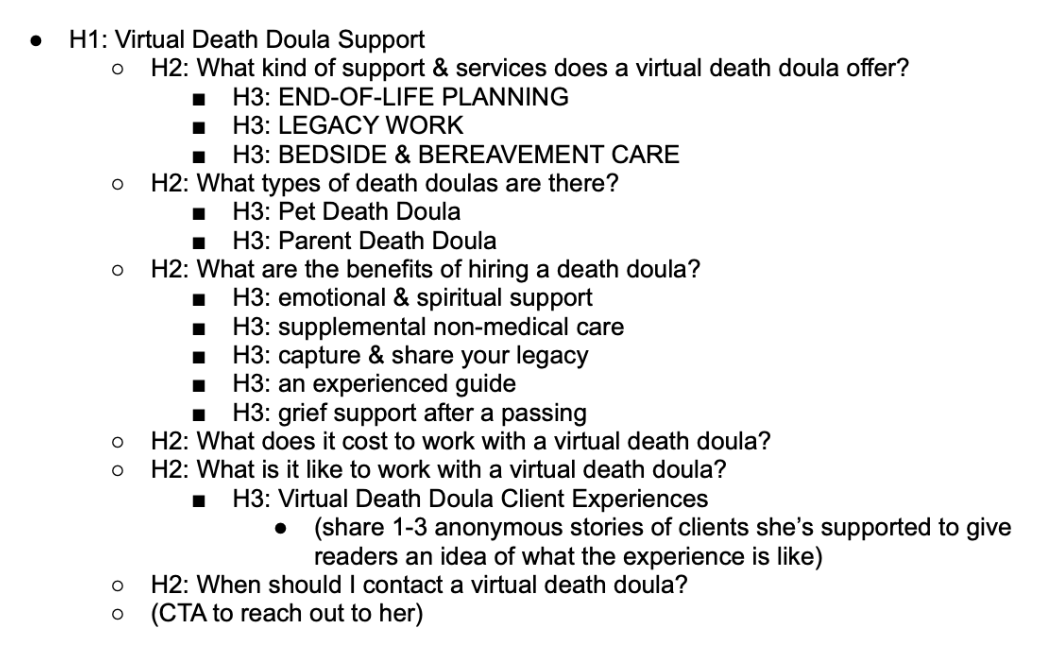
Hello and welcome back to the Basic B Podcast. I'm your host and favorite SEO coach, Brittany Herzberg, and I'm coming to you from a very cold December day in Connecticut. But it's all good because last week we had our very first snow. And as someone who was born in Kentucky, lived in Michigan, but was mostly raised in North Carolina, I love the snow. But you are not here for that. Let's get into the topic of the day, which is using headlines to get found in AI searches. So I know we tend to go vague with our headings and use them almost like a throwaway in copywriting, but omg, this is not the place to do either of those things. Here's what you need to know. Headings don't just matter on blog posts. They matter on your main website pages as well. I'm talking home about services, even your freebie pages, sales pages, and other landing pages. Those cute little robots that go scour the Internet when someone asks a question in Google or ChatGPT. They're helpful, but they're not the most intelligent. They need things to be so simple, so clear, so specific. And that especially applies to headlines. The better they can understand something quickly, the more likely they are to serve up your site on a silver platter to that person who's literally searching for you. Let's dive a little deeper into something called heading hierarchy. I go into this concept in great detail in the Business Owner's Guide to Blogging, so you may be familiar with this concept. Heading hierarchy is the most ideal way to actually organize information on a page. It goes from H1 all the way down to H6, but most people only use H1 to H3, so those are the ones I'm going to be focusing on. But you'll see how this works and how it can be applied to the H4s, 5s, and 6s. So H1 headlines are the big headlines at the top of a page, a webpage, or a blog post. And you've heard me say it before. If you've been around for any length of time, there needs to be one and only one H1 for every page. This is the headline where you'll ensure the target keyword or keywords for that page are put to really good use. The main mistake to avoid with H1 headings is leaving it too short and simple. Example your about page says about or your blog page says Blog. We can do so much better. Okay, there isn't a set character count like there is for an SEO title, but pro tip, you can use the SEO title as your H1 heading. I do this all the time for blog posts and Podcast episodes that turn into blog posts. It keeps it easy and cohesive. It's also a workaround for a sneaky little thing that search engines often do, which is to use your H1 instead of your SEO title. Sometimes this happens. And yes, before you even DM me, it is still worth it to fill in your SEO title properly. That's still information that the robots need. We do not need them making any guesses, okay? We want it to be as clear and concise as possible. Now, if you don't want to use your SEO title as your H1, no problem. You want to at least ensure you've got the target keyword in the H1. You can often do this just by thinking how can I get more specific here? Example A client I worked with recently had real people, real brands, real results as her H1. The page was all about client results, and after doing a little bit of keyword research, I drafted an H1 that says coaching client Success stories with a bar the Transformation Gallery. It's not that her original H1 was wrong, it just wasn't a strong one. It wasn't able to go out and actually work for her. There were no keywords in there. For example, this client also happened to have 20 +H1s on all of her main website pages, and this was a newly designed website. I'll have to come back and share more about this project for sure, but I'm mentioning it because I want you to know it happens all the time where there are too many H1s on a page and the fix is really simple. For example, this month her design team is going in to format those quote unquote extra H1s as H2s and H3s. They're going to be using this heading hierarchy. So let's move on to those now, shall we? H2s and H3s get nestled under the H1. There is no maximum or minimum H2s or H3s required for a web page or blog post like there is for an H1. Here's how this heading hierarchy works. There's one H1 for a page. The H2 headings support the H1 heading, and the H3s support the H2 heading that they're under. I'll say this another way. There's one H1 on every page. The big idea of the H1 gets broken into smaller ideas which become the H2 headings. The big idea of the H2 gets broken down into even smaller ideas which then become the H3 headings. The headings are like building blocks and it may help you to think of this from a top down approach where you have a big idea that gets broken down or your brain may like it better to think of it from a ground up approach. So play around with this, let your brain have some fun, but just think of it like building blocks. Something I see quite often with H2s and H3s is that there are so many opportunities to get just a little more specific. An example of this is a blog post I optimized recently from one of my monthly SEO support clients. She had a blog about loneliness during the holidays. One of her H2s said how doubt shows up during the holidays and I made one simple change to have it read how self doubt shows up during the holidays. I made that change after I did a little keyword research to see what people are actually searching for. So yes, the tweaks you make can be very very tiny but mighty. To bring this all home, let's walk through an example. This is a topic blog that I did for someone just recently. Someone in my maintain membership brought me the most perfect example just a few days ago, so we're going to roll with that. She has a blog that's performing really really well, but the angle of her work has changed. So my suggestion was to take the same blog and modify it just a little bit. This is how she could have her headings organized and I'll add a screenshot of what I'm actually reading from in the blog for this episode, which will be linked below. So just know that you can go there if you are more of a visual learner. I'll read the heading type and what the heading could say. H1 virtual death doula support H2 what kind of support and services does a virtual death doula offer? H3 End of life planning H3 Legacy work H3 Bedside and bereavement care H2 what types of death doulas are there? H3 Pet death doula H3 Parent death doula H2 what are the benefits of hiring a death doula? H3 Emotional and spiritual support H3 Supplemental non medical care H3 Capture and share your legacy H3 an experienced guide H3 Grief support after a passing H2 what does it cost to work with a virtual death doula? H2 what is it like to work with a Virtual Death Doula? H3 Virtual Death Doula client experiences and in this area she could have several different H3s where she shares anywhere from one to three anonymous stories of clients she's supported to give readers a really impactful idea of what the experience is like H2 when should I contact a virtual death doula? And then she could wrap this up with a call to action, either as a hyperlink or a button for people to actually reach out to her. Hopefully that helps. You have an idea of how to effectively use H1, H2 and H3 headings for a blog post the same logic applies with a web page. The most important things to remember when it comes to headings are to keep it short and simple. Use enough words so the robots can easily and quickly make sense of what's being shared, and so humans can easily skim the material to find what they need. I know you pour your heart and soul into these webpages and blog posts, but our attention spans have gotten so short and most people skim the headings to find what they're looking for. So just bear that in mind. You also want to keep it clear versus Clever. Not only do you want to keep it pretty concise, you want to be very clear with your headlines. Again, because you're dealing with robots who don't quite get the wittiness you possess, and because humans are in a hurry, go clever in the body copy, not the headlines. And you want to keep it specific. When in doubt, look for opportunities to be just a little bit more specific with those headlines. What type of coach? What type of service? What type of business owner? That specificity will help the robots and humans better understand who you help and how. Which makes it much more likely that one you'll show up in search and two that you'll land a new lead and make a sale in your sleep. We've covered a lot. It can be so much to digest, but it's so, so helpful for boosting your visibility and actually helping you get found by people who are literally looking for you. If you'd like more information on how to optimize your blog posts, be sure to check out the Business Owner's Guide to Blogging or book an SEO strategy session if you'd like to talk through the headings on your own website. This is also something we dive really deep into in SEO and grow. So that's another option for you. You can always secure your spot before the next round of the program opens. Check the details below and reach out with any questions that you might have. I for one would love to know what aha moments you had during this episode. DM me on Instagram or use the text button below to share them with me. And until next time, know I'm over here cheering you on on your SEO journey.